Permits are the step that stalls the most kitchen projects in Issaquah, and usually not because the rules are complicated. It is because homeowners are unsure which work actually triggers a permit, and because Issaquah handles a few things differently from neighbouring cities. Electrical does not go where you might expect. Paper applications are not accepted at all. And some homes with Issaquah addresses are not under Issaquah's jurisdiction.
This guide covers all of it: what needs a permit, what does not, how to apply, who inspects what, and the local details that catch people out.
Quick answerA kitchen remodel in Issaquah needs a permit once it changes structure, plumbing, or mechanical systems. Cosmetic work in the same footprint generally does not. Applications go online through MyBuildingPermit.com, and the City of Issaquah does not accept paper submittals for single-family remodels. Electrical permits are handled separately by Washington State Labor and Industries, not the city.
- First: are you actually in Issaquah?
- When does an Issaquah kitchen remodel need a permit?
- Issaquah applies online only
- Who issues what
- Codes in effect
- The process, step by step
- What it costs and how long it takes
- What happens if you skip the permit
- Frequently asked questions
- Official Issaquah resources
First: are you actually in Issaquah?
Start here, because this catches more homeowners than any other issue in this guide.
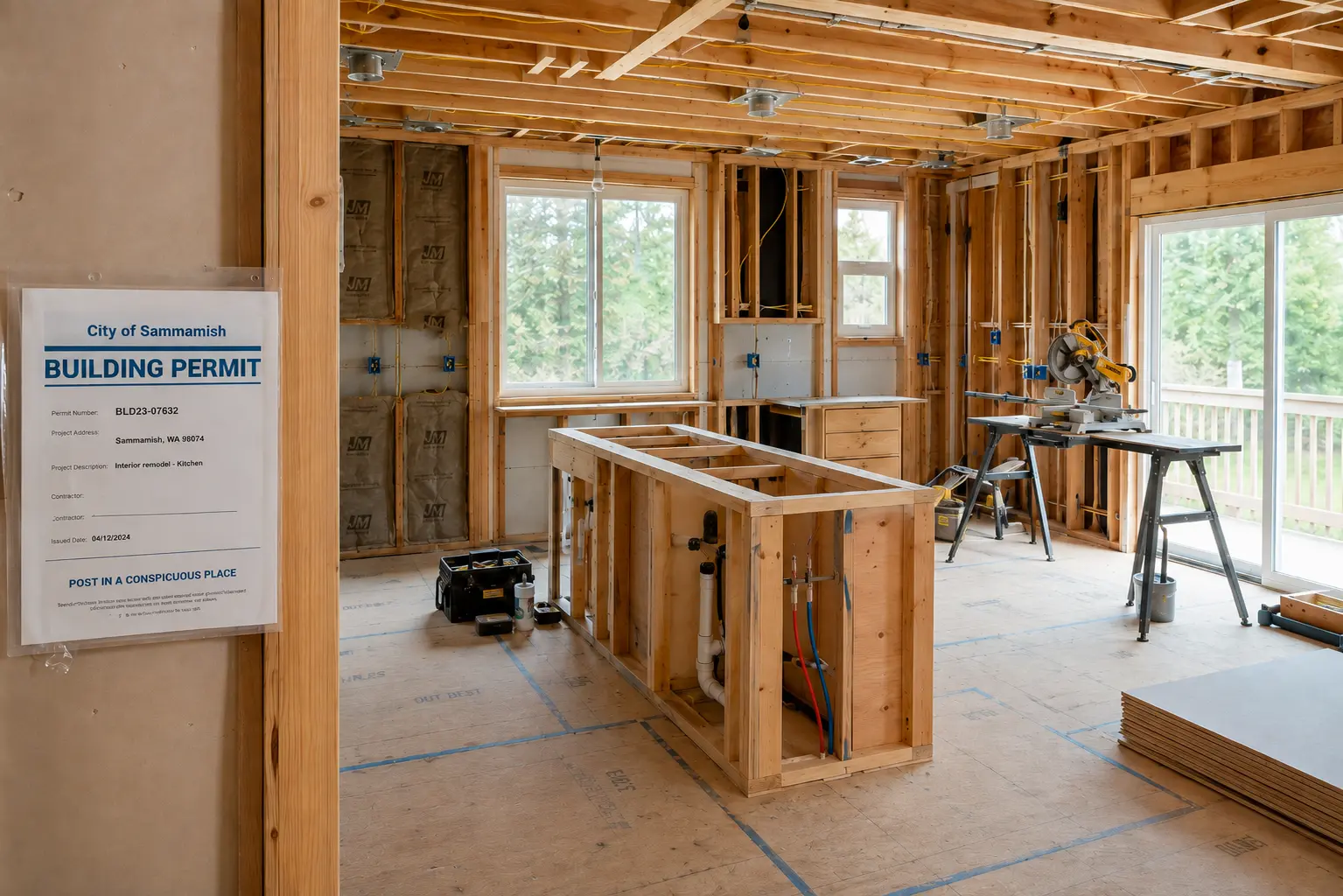
Several neighbourhoods carry an Issaquah mailing address but sit outside the city limits, which means the City of Issaquah does not handle their permits at all. Klahanie is under the City of Sammamish Permit Center. Mirrormont and other unincorporated areas fall under the King County Department of Permitting and Environmental Review.
Applying to the wrong jurisdiction wastes weeks. If there is any doubt about which side of the line your property sits on, call the Issaquah Permit Center at 425-837-3100 and confirm before you submit anything.
When does an Issaquah kitchen remodel need a permit?
The city's rule follows systems rather than rooms. Change what is behind the walls and you need a permit. Change only the surfaces and usually you do not.
Permit required:
- Removing, moving, or adding a wall, including opening the kitchen to a living or dining space
- Relocating or adding plumbing: a new sink position, a pot filler, a moved dishwasher drain, or new supply, drain, or vent lines
- New or relocated electrical, including circuits for an induction range or a service panel upgrade
- Mechanical work such as a new or relocated range hood ducted to the exterior, or gas line changes
- Structural alterations of any kind, and window or door openings
Generally no permit required:
- Replacing cabinets or countertops in the same layout
- Painting, tiling a backsplash, and refinishing surfaces
- Non-structural flooring where the subfloor is untouched
- Like-for-like fixture replacement in the same location with no change to supply or drain lines
One important caveat straight from the city: even for work that is otherwise exempt, plumbing, electrical, and mechanical permits may still be required depending on what the job touches. When a project sits near the line, the Permit Center is the place to settle it.
Issaquah applies online only
This is the procedural detail that surprises people most. Single-family interior remodel permits in Issaquah must be submitted through MyBuildingPermit.com, the regional portal shared across many Washington jurisdictions. The city does not accept paper applications or paper plans for these projects.
Expect to prepare a submittal package rather than a single form. The city publishes a Single Family Interior Remodel submittal requirements packet listing what is needed, and there are specific PDF formatting requirements for uploaded plans. Files that do not meet those specifications get returned, which costs you a review cycle.
If your project adds an accessory dwelling unit, a King County Sewer Use Certification Form is also required.
Who issues what
Issaquah splits permitting across two authorities, and getting this wrong costs time.
| Permit type | Issued by |
|---|---|
| Building and structural | City of Issaquah, Community Planning and Development |
| Plumbing | City of Issaquah |
| Mechanical | City of Issaquah |
| Electrical | Washington State Department of Labor and Industries |
Electrical is the one to note. Unlike some neighbouring cities that review and inspect their own electrical work, Issaquah routes electrical permits to state L&I. The nearest L&I office is in Bellevue at 616 120th Avenue NE, Suite C201, reachable at 425-990-1400, and many electrical permits can be obtained online.
There is a second requirement that catches contractors as well as homeowners: even though L&I issues the electrical permit, any contractor performing work inside Issaquah city limits needs a City of Issaquah business license. Ask your contractor to confirm they hold one before work begins.
Codes in effect
Issaquah City Council adopted the 2021 International Building and Fire code series, effective March 15, 2024, layered on the state-adopted code set. For a kitchen, the practical implications are the familiar ones: GFCI protection on countertop receptacles, exhaust ventilation ducted to the exterior, and Washington State Energy Code compliance where you open exterior walls or ceiling cavities.
Because code editions cycle and local amendments change, confirm the current adopted set with the city before finalizing plans rather than relying on any guide, including this one.
The process, step by step
- Confirm jurisdiction. Verify your address is inside Issaquah city limits, not Klahanie or an unincorporated area.
- Confirm scope. Determine which permits apply: building, plumbing, mechanical, and whether an L&I electrical permit is needed.
- Prepare the submittal package. Follow the Single Family Interior Remodel requirements and the city's PDF formatting rules.
- Apply through MyBuildingPermit.com, selecting City of Issaquah as the jurisdiction.
- Plan review. Staff review the submittal and issue correction items. Respond completely, since partial responses are the most common cause of a stalled review.
- Pay fees and receive the permit. Fees vary by project valuation and scope, and additional third-party or hourly review fees can apply.
- Build and inspect. Rough inspections for plumbing and mechanical, plus L&I inspection for electrical, then a final inspection that closes the permit.
A note on mechanical work: some single-family fixture installations, including certain gas appliances, qualify for over-the-counter issuance online, which means the permit is issued immediately without plan review.
What it costs and how long it takes
Issaquah sets permit fees by project valuation and scope rather than a flat rate, and the city notes that outside, third-party, and hourly review fees may apply on top of standard fees. As a planning allowance, budgeting roughly 0.5 to 1.5 percent of project cost for permits on a kitchen or bathroom is realistic, though the city's published fee schedule is the source of truth for your project.
Timelines depend on whether your scope needs plan review. Structural work goes through full review, while simpler mechanical and plumbing work can move quickly, and some items issue immediately over the counter. Build the review window into your schedule before you set a demolition date rather than after.
What happens if you skip the permit
Unpermitted kitchen work creates three problems, and all of them cost more than the permit would have.
The city can issue a stop-work order, and bringing unpermitted work into compliance often means opening finished walls so concealed plumbing, framing, and mechanical work can be inspected. You pay to build it, then pay to expose it.
At resale, unpermitted work surfaces through the permit history or a buyer's inspection, and Washington's seller disclosure obligations make it something you must address rather than something you can quietly leave.
And insurers can deny claims tied to unpermitted, uninspected work. If a supply line fails behind a wall that was never inspected, that is a conversation you do not want to have.