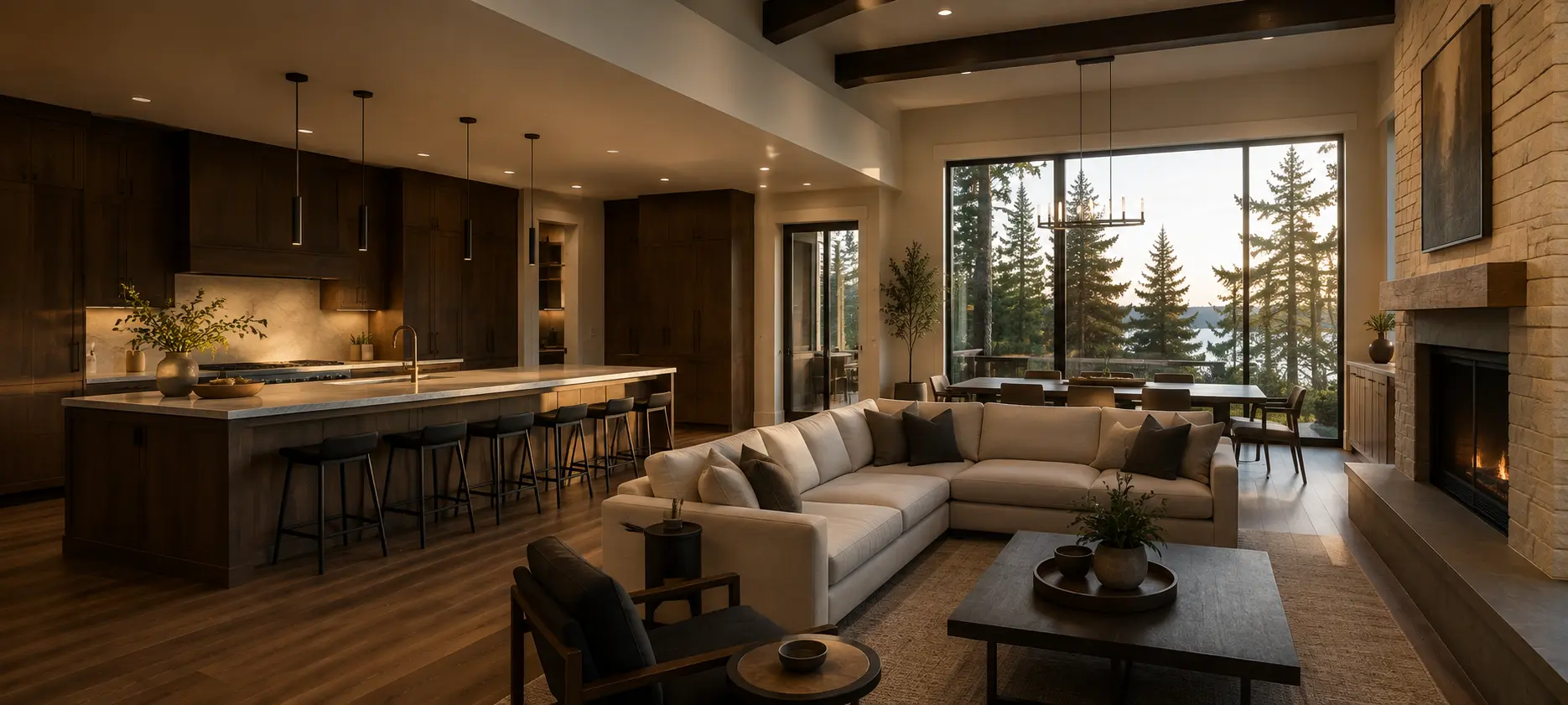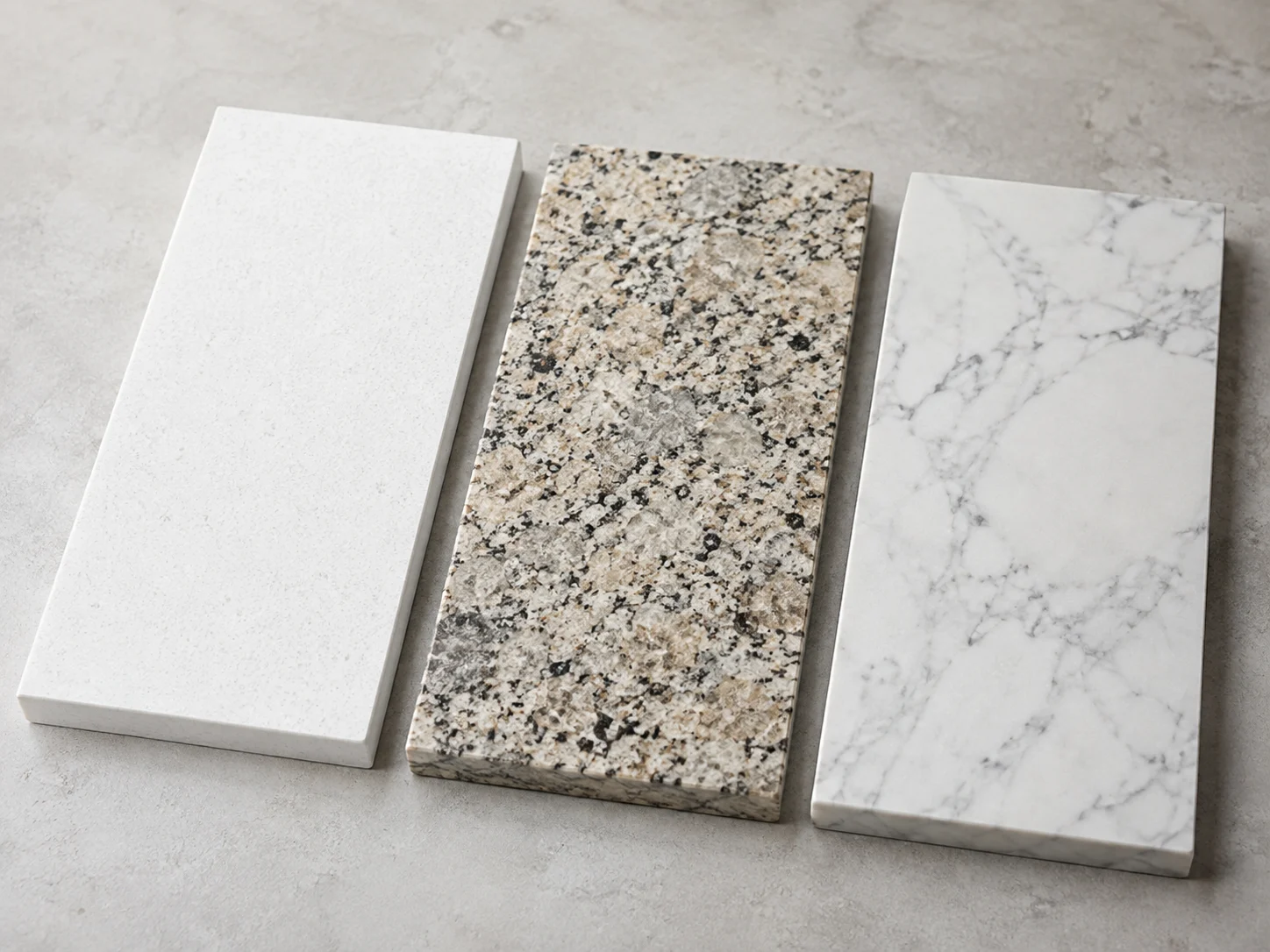
Countertops are the most touch-intensive decision in your whole kitchen. They set the aesthetic tone of the room and they take the daily beating: the hot pans, the wine, the lemon juice, the kids doing homework. So the material you pick matters more than almost any other finish.
The dilemma is choice. Between engineered slabs and natural stones, dozens of colors, and a wall of samples, how does a Kent homeowner balance beauty, durability, and cost? This guide puts quartz, granite, and marble side by side and weighs each against the things that actually matter here in South King County: family durability, the moisture and low winter light of the Pacific Northwest, and resale value. If you are also deciding on slab thickness, pair this with our 2cm vs. 3cm countertop guide.
Quick answerChoose quartz for a busy, low-maintenance kitchen that never needs sealing and stays bright. Choose granite for 100 percent natural stone that shrugs off hot pans and lasts. Choose marble for luxury veining on a low-use island or baking station, accepting that it etches and needs care. In the Pacific Northwest, quartz is the popular all-rounder, but the right pick depends on how you cook and live.
- Quick comparison matrix
- Quartz countertops: the low-maintenance PNW favorite
- Granite countertops: timeless, one-of-a-kind durability
- Marble countertops: unmatched luxury and character
- Local sourcing & slab selection in King County
- Cost factors & budget planning for Kent remodels
- Which countertop should you choose?
- Frequently asked questions
- Select the right countertop for your Kent kitchen
Quick comparison matrix
Here is the at-a-glance version before the details.
| Feature | Engineered quartz | Natural granite | Natural marble |
|---|---|---|---|
| Origin | Engineered (about 90% quartz plus resin) | 100% natural igneous rock | 100% natural metamorphic rock |
| Porosity and sealing | Non-porous, never needs sealing | Slightly porous, seal every 1 to 2 years | High porosity, seal every 6 to 12 months |
| Scratch and stain resistance | Very high | High | Moderate (prone to etching and stains) |
| Heat resistance | Moderate (use trivets) | High | High |
| Cost band | Mid to high | Mid-range | High to luxury |
Quartz countertops: the low-maintenance PNW favorite
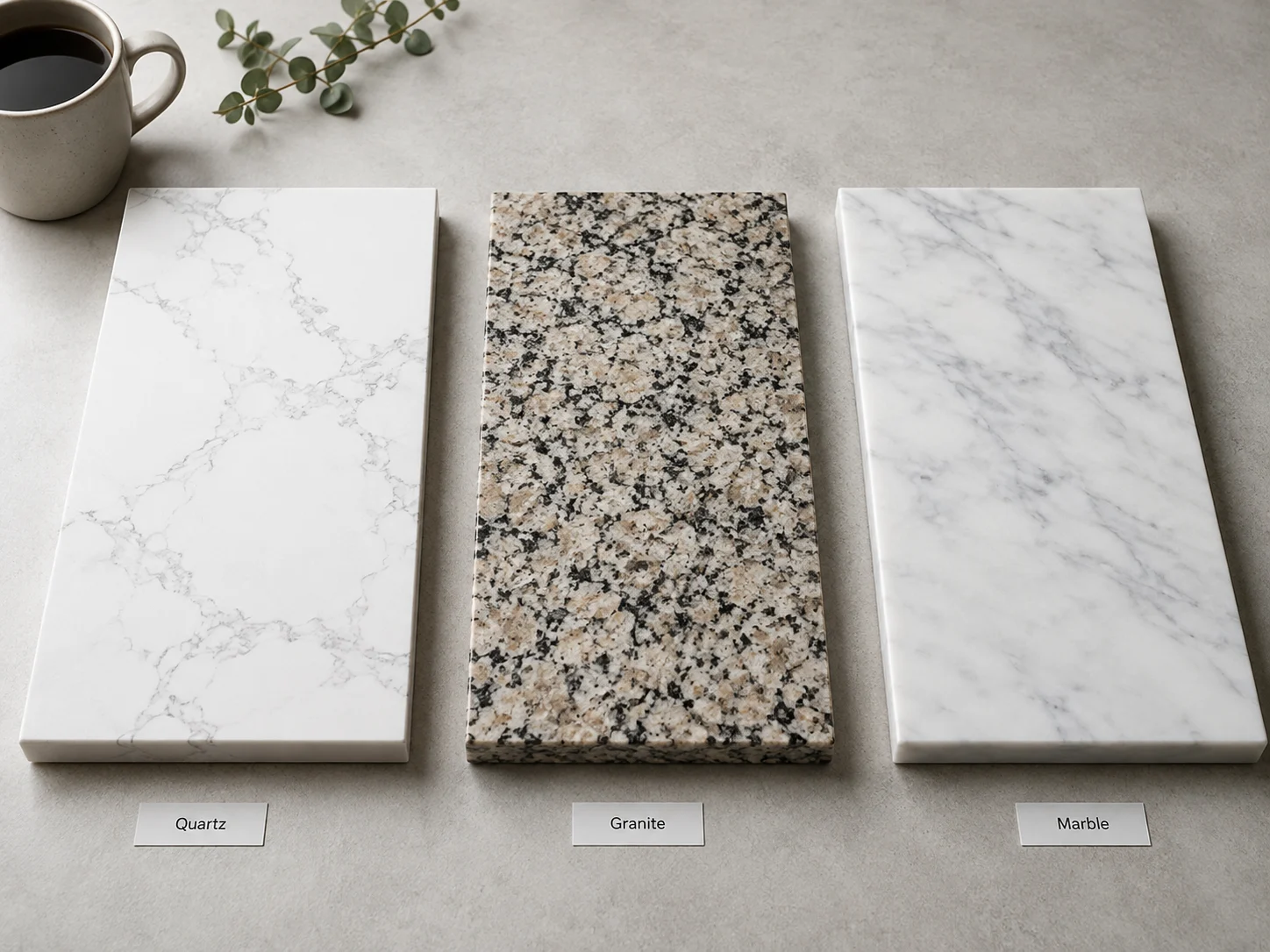
Quartz is engineered, roughly 90 percent ground natural quartz bound with resin, which makes it non-porous. That single property is why it is so popular in Kent homes. A non-porous surface resists moisture, spills, and mold, which suits busy households and the low natural light of gloomy Northwest winters, where a bright, clean surface earns its keep. It is no accident that local suppliers market their quartz lines as moisture-resistant and built for the Pacific Northwest.
The pros are practical. Quartz needs zero sealing, ever, and resists stains from wine, coffee, and oils. Its patterns are extremely consistent, so it can mimic a white Calacatta marble look without the delicate upkeep.
The cons are worth knowing. Quartz is susceptible to thermal shock, so a hot pan set straight down can leave a resin burn. Always use trivets. And it is not ideal outdoors, since UV light can discolor the resin over time.
Best suited for: busy families in East Hill and West Hill, high-use kitchens, and modern open-concept designs.
Granite countertops: timeless, one-of-a-kind durability
Granite is 100 percent natural igneous rock, and its appeal is that no two slabs are alike. Every slab has its own movement, veining, and character formed over millions of years, so your counter is genuinely one of a kind.
The pros are serious. Granite has exceptional heat tolerance, so you can take a hot pot straight from the stove to the counter. It is extremely durable against scratches and everyday wear, and it holds strong resale value as a proven natural stone.
The cons are manageable. Granite is slightly porous, so it needs periodic sealing, typically once every 1 to 2 years, to resist staining. And depending on the stone's pattern and movement, slab seams can be more visible on large runs.
Best suited for: traditional or craftsman-style homes in the Kent Valley, serious home cooks, and homeowners who want a unique natural stone.
Marble countertops: unmatched luxury and character
Marble is the high-end statement: classic, elegant, and timeless. It is natural metamorphic rock, and it is often the pick for luxury primary suites, dedicated baking centers, or an accent island.
The pros are about beauty and function in equal measure. Marble stays naturally cool, which makes it ideal for rolling pastry dough, and its soft veining and luminous depth are something engineered stone cannot fully replicate.
The cons are real and should guide where you use it. Marble is highly porous, so acidic foods like lemon juice, tomatoes, and coffee cause chemical etching, dull marks in the surface. It is a softer stone that can scratch or chip under heavy use, and it needs strict maintenance and frequent sealing, roughly every 6 to 12 months. For the science of etching and sealing, the Natural Stone Institute is the authority.
Best suited for: low-impact focal points like an island feature, a dedicated baking station, or a luxury full-home remodel.
Local sourcing & slab selection in King County
Natural stone is dynamic, so a 4 inch by 4 inch sample tells you almost nothing about how a full granite or marble slab will look. The movement, the veining, and the color shift across the slab, which is why you view the actual slab in person before you buy.
Kent homeowners are lucky here. The Kent Valley, especially the corridor along 62nd and 64th Avenue South, is one of the region's densest clusters of slab yards, so full-slab showrooms are close to home. You can see real slabs under proper lighting at suppliers like Architectural Surfaces (PentalQuartz) and Stratus Surfaces in Kent, MSI Surfaces, and Meta Marble & Granite, plus Daltile's Stone and Slab Center in Seattle. Seeing the slab under correct lighting before fabrication is the difference between the counter you pictured and the one you get.
Fabrication then shapes the cost. Sink and cooktop cutouts, your edge profile (eased, bevel, bullnose, or a waterfall drop), and where the seams fall all affect how much of each slab gets used, and slab yield drives the price as much as the material does.
Cost factors & budget planning for Kent remodels
The number that surprises people is how much of a countertop budget is not the stone. Material is only part of it. Fabrication and installation, the cutting, edging, undermount prep, and fitting, often make up a large share of the total, sometimes around half. That is why two counters in the same material can price very differently.
The big cost drivers are consistent:
- Complex edge profiles or a waterfall drop, which add fabrication labor.
- The number of sink and cooktop cutouts and the undermount plumbing preparation.
- Slab waste efficiency, since matching seams and veining across a large island can require more material.
Thickness plays in here too, which is why the edge you choose and the slab you buy are linked. Our 2cm vs. 3cm countertop guide breaks that part down.
Which countertop should you choose?
It comes down to how you cook and what you value.
In short: pick quartz if you prioritize low maintenance, a bright modern look, and stain resistance. Pick granite if you want 100 percent natural stone durability, heat tolerance, and timeless appeal. Pick marble if you want luxury patina, a specialized baking area, and unmatched classic elegance in a spot that will not take heavy daily abuse.