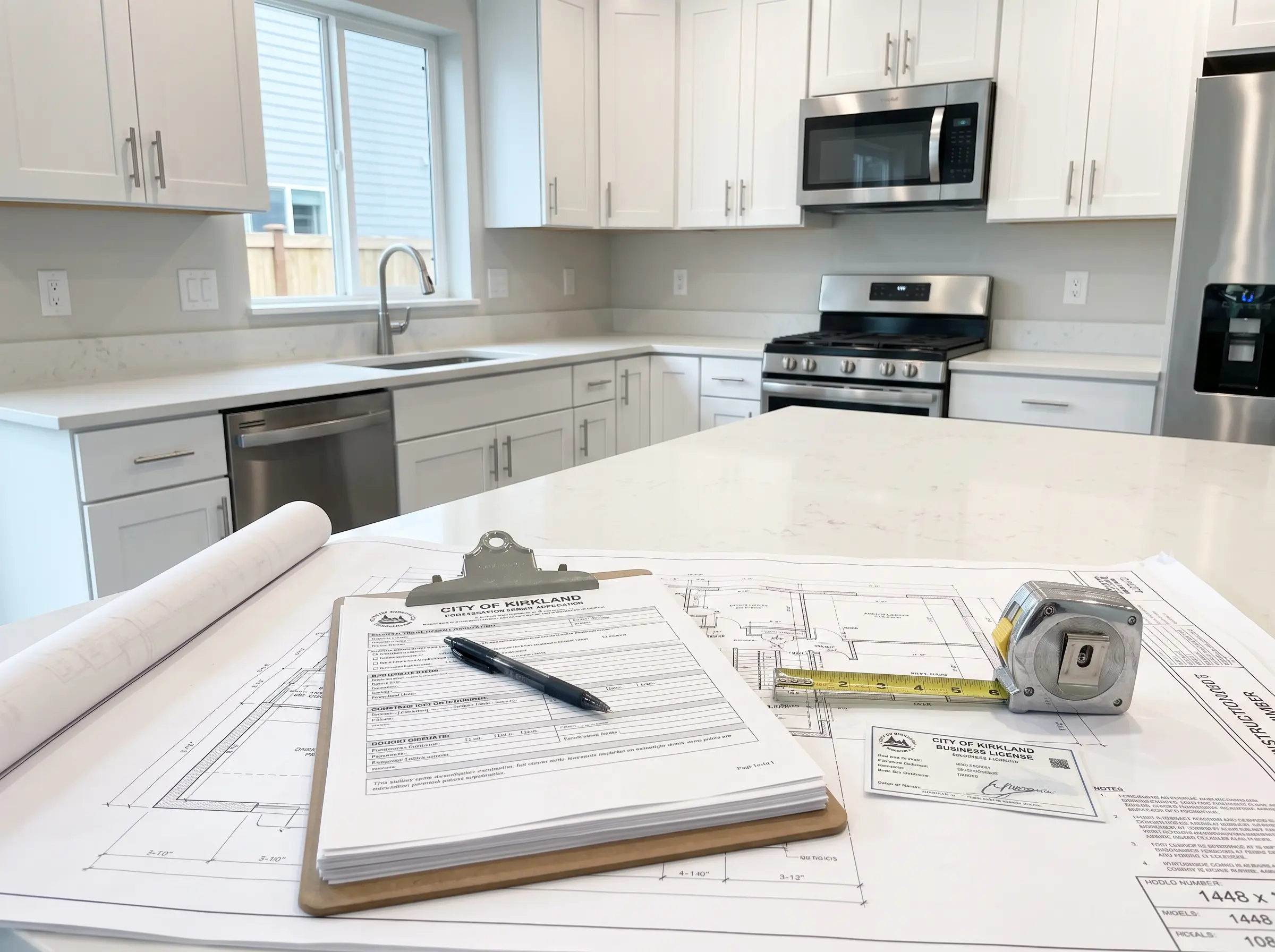
Permits are the step Kirkland homeowners most want to skip and least can afford to. The rules are not arbitrary: they exist for life safety, energy code compliance, fire prevention, and to protect you at resale. And in Kirkland they are more knowable than most people assume, because the line between exempt work and permitted work is written into the Kirkland Municipal Code.
This guide covers where that line falls, the two kinds of permits Kirkland issues, how to apply, and what happens if you skip the process.
Quick answer- No permit needed: purely cosmetic changes, including replacing cabinets, countertops, tile, or flooring, and swapping a fixture like for like in the same location without altering plumbing or electrical lines. - Permit required: moving or removing walls (load-bearing or not), rerouting gas lines, extending electrical circuits, relocating plumbing drains or vents, and replacing sheetrock. - How to apply: online through Washington's regional portal, MyBuildingPermit.com, selecting City of Kirkland as the jurisdiction. - Who to ask: the City of Kirkland Development Services Center, City Hall, 123 5th Ave, Kirkland, WA 98033.
- Understanding Kirkland's remodeling regulations
- When do you NOT need a permit in Kirkland?
- When is a building permit mandatory for kitchens & baths?
- Types of Kirkland remodeling permits: OTC vs. full plan review
- How to submit your permit application via MyBuildingPermit.com
- Contractor verification & additional local regulations
- What happens if you remodel without a permit in Kirkland?
- Kirkland remodeling permit FAQs
- Final steps & official Kirkland resources
Understanding Kirkland's remodeling regulations
Residential construction inside Kirkland is governed by Chapter 21.06 of the Kirkland Municipal Code, the city's Construction Administrative Code. That chapter adopts the technical codes Washington uses, including the International Residential Code, the International Building Code, the Uniform Plumbing Code, and the Washington State Energy Code, and it sets out how the city administers permits, plan review, and inspections.
Two provisions matter most for a kitchen or bath project. KMC 21.06.205 addresses work that requires a permit, and KMC 21.06.215, titled "Work exempt from permit," lists the work that does not. The exemption section carries an important caveat worth understanding: an exemption from permit requirements does not authorize work to be done in violation of the technical codes or any other law. In plain terms, exempt does not mean unregulated. Your like-for-like fixture swap still has to meet code, you just do not need a permit to do it.
Kirkland also has one distinction that separates it from several neighboring cities: it reviews and inspects its own residential electrical permits through Development Services, rather than routing them to the Washington State Department of Labor and Industries. If you have remodeled in a city where L&I handled the electrical, do not assume the same process here.
When do you NOT need a permit in Kirkland?
Finish work is generally exempt. If your project changes surfaces and nothing behind them, you are usually clear. The table below covers the common exempt kitchen and bathroom updates, and the condition each exemption depends on.
| Kitchen or bathroom upgrade | Why it is exempt | Essential condition |
|---|---|---|
| Cabinet and countertop installation | Considered finish work | No electrical or plumbing relocation |
| Tile, hardwood, or vinyl flooring | Non-structural finish | Existing subfloor remains intact |
| Painting and wallpapering | Aesthetic improvement | No wall removal or repair beyond minor patching |
| Like-for-kind fixture swap | Maintenance or repair | Replacing a sink, toilet, or faucet in the exact same location without modifying supply or drain lines |
| Like-for-kind appliance swap | Maintenance | Swapping a dishwasher or range without running a new gas or 240V line |
Notice how much weight the third column carries. A cabinet replacement is exempt right up until you move an outlet to suit the new layout. The exemption describes the work, not the room, so a project can cross the line mid-job.
When is a building permit mandatory for kitchens & baths?
Once the work reaches structure or any trade system, Kirkland requires review. These are the four categories that trigger a permit.
1. Structural and layout changes
- Removing, adding, or relocating interior walls. This applies to non-load-bearing partitions as well as load-bearing walls, so "it is just a partition" does not exempt you.
- Cutting new window or skylight openings, or altering exterior framing.
- Removing or installing sheetrock and drywall, which commonly triggers insulation and mechanical inspection because it exposes the cavity.
2. Plumbing alterations
- Moving a sink, shower, toilet, or tub to a new location.
- Adding drainage lines, vent stacks, or water supply lines.
- Installing a new gas line for a kitchen range or a gas fireplace insert.
3. Electrical work
- Adding new circuits, such as a dedicated 50A circuit for an induction cooktop or dedicated 20A GFCI circuits for bathroom receptacles.
- Relocating light fixtures, outlets, or subpanels.
As noted above, these are reviewed and inspected by City of Kirkland Development Services, not by state L&I. That matters for scheduling, because your inspections are coordinated through the same city process as the rest of the job.
4. Mechanical and ventilation systems
- Rerouting or installing new range hood ductwork, which is central to managing Pacific Northwest cooking moisture.
- Adding or replacing bathroom exhaust fans, which must meet CFM venting requirements sized to the room.
- Installing in-floor radiant heating.
Types of Kirkland remodeling permits: OTC vs. full plan review
Kirkland handles permits on two tracks, and knowing which one your project lands on tells you most of what you need to know about your timeline.
Over-the-counter (OTC) permits cover simple trade work: a like-for-kind mechanical replacement, or straightforward plumbing or electrical work with no structural alteration. Because no plan review is needed, these can be issued quickly, often within about one to three business days.
Combination building permits go through full plan review. These are projects that need architectural floor plans, structural calculations, and energy compliance documentation. Review commonly takes several weeks, roughly three to six weeks depending on the city's workload and how many correction cycles your plans require. If your kitchen remodel removes a wall, assume this track and build the review window into your schedule before you set a demolition date. Anything that enlarges the house sits firmly on this track and adds a step before it: a Kirkland home addition is checked against the setbacks, lot coverage, and height limits for your zone before the building permit itself is assessed, so the front end runs longer than a remodel contained inside the existing footprint.
How to submit your permit application via MyBuildingPermit.com
Kirkland participates in MyBuildingPermit.com, the regional online portal shared by many Washington jurisdictions. The process runs in five steps.
- Property research. Check zoning, tax records, and prior permit history for your address using the city's mapping tools. Past permits tell you what has already been approved and what may have been done without a permit.
- Prepare submittal documents. For plan-review projects, expect scaled floor plans (commonly 1/8 inch equals 1 foot), a demolition plan, the proposed layout, a lighting plan, and Washington residential energy code compliance forms.
- Portal submission. Create an account on MyBuildingPermit.com, select City of Kirkland as the jurisdiction, and upload your documents.
- Intake and plan review. City staff review the application and issue plan check comments. Respond completely and promptly, since incomplete responses are the most common cause of a stalled review.
- Issuance and inspections. Once the permit is issued, work can begin. Expect rough inspections for plumbing, electrical, and mechanical, then framing and insulation, and finally a final inspection that closes the permit.
Contractor verification & additional local regulations
Three checks protect you before anyone starts work.
Washington L&I registration. Contractors in Washington must be registered, bonded, and insured. Verify any contractor on the state's Verify a Contractor tool before signing. An unregistered contractor leaves you exposed.
City of Kirkland business license. State registration is not the whole story. A contractor working inside Kirkland city limits also needs a valid City of Kirkland business license to pull permits there. It is a quick question to ask, and a telling one.
Condo and HOA rules. City approval is not the only approval. Downtown Kirkland condo and townhome owners typically also have to satisfy HOA bylaws, which commonly govern work hours, elevator and common-area protection, neighbor notification, and limits on relocating plumbing stacks. Those two tracks run in parallel, so start the HOA conversation as early as the permit one.
What happens if you remodel without a permit in Kirkland?
Skipping the permit does not save money, it defers and multiplies the cost. The consequences fall into three buckets.
City enforcement. Unpermitted work can draw a stop work order, and cities commonly charge elevated fees for work started without a permit. The most expensive part is exposure: to inspect concealed work, you may have to tear out finished sheetrock and tile so the rough plumbing, electrical, and framing can be seen.
Resale problems. Unpermitted work surfaces during a King County sale. Washington's seller disclosure statement, Form 17, asks about work done on the property, a buyer's inspector often spots non-conforming work, and a lender can decline to finance a home with unpermitted structural or trade alterations. That turns into a price concession or a dead deal at the worst possible moment.
Insurance exposure. If a pipe bursts, a fire traces back to a circuit, or water damages the framing, an insurer can deny the claim on the grounds that the work was never permitted or inspected. The permit is cheap compared with an uncovered loss.