Not every dollar in a bathroom remodel comes back the same way. Some choices add value that a buyer sees in the first two seconds and a family feels every morning. Others look luxurious on a mood board and quietly disappear at resale. Knowing the difference is what separates a remodel that pays off from one that just costs a lot.
We remodel bathrooms across the Eastside, and the pattern is consistent: value concentrates in a handful of moves, most of them practical, most of them inside the existing footprint. Here is what adds the most value during a bathroom remodel, backed by resale data and by what actually holds up in a used bathroom.
Quick answerThe upgrades that add the most value are the broadly appealing ones done well: a clean walk-in or updated shower, strong lighting, real ventilation, a quality vanity and countertop, water-saving fixtures, and durable neutral tile. Midrange remodels recoup the most, about 80 percent of cost at resale in the 2025 Cost vs. Value Report, while luxury finishes recoup far less. Fix the function first, then spend on finishes.
- What "value" really means in a bathroom remodel
- Fix the function first: the value you cannot see
- The visible upgrades that add the most value
- Universal design: value that grows with the market
- Water-saving fixtures: small spend, real appeal
- What to skip when you remodel for value
- Which upgrades should you prioritize?
- Frequently asked questions
- Plan a bathroom remodel that pays off
What "value" really means in a bathroom remodel
Value has two halves: what you get back at resale, and what you enjoy while you live there. The resale half is measured as ROI, the share of your cost recouped when you sell. The livability half does not show on a spreadsheet, but it is why most people remodel in the first place.
The resale data is clear on one thing: the middle of the market wins. According to the 2025 Cost vs. Value Report, a midrange bathroom remodel recoups about 80 percent of its cost, its strongest showing since 2007, while an upscale remodel recoups closer to 42 percent. A universal design remodel, built for accessibility, lands around 61 percent and is climbing. The lesson is not to cheap out. It is that broadly appealing, well-built work in the existing footprint returns more than luxury finishes that suit a narrow pool of buyers.
Fix the function first: the value you cannot see
The most important value in a bathroom is invisible when the job is done right and catastrophic when it is done wrong. A properly built shower pan, a waterproofed wet wall, solid plumbing, and a subfloor with no rot are what keep the finishes you paid for from failing in five years. In the Pacific Northwest, moisture is the enemy, and a bathroom that traps it quietly destroys its own value.
This is why we tell homeowners to spend on the parts nobody photographs before the parts everybody does. A gorgeous tile shower over a bad pan is a future demolition. Get the waterproofing, the venting, and the plumbing right, and every visible upgrade on top of it lasts.
The visible upgrades that add the most value
Once the function is sound, value concentrates in a short list of upgrades. The plan below shows where it lives in a typical bathroom.
A few carry the most weight:
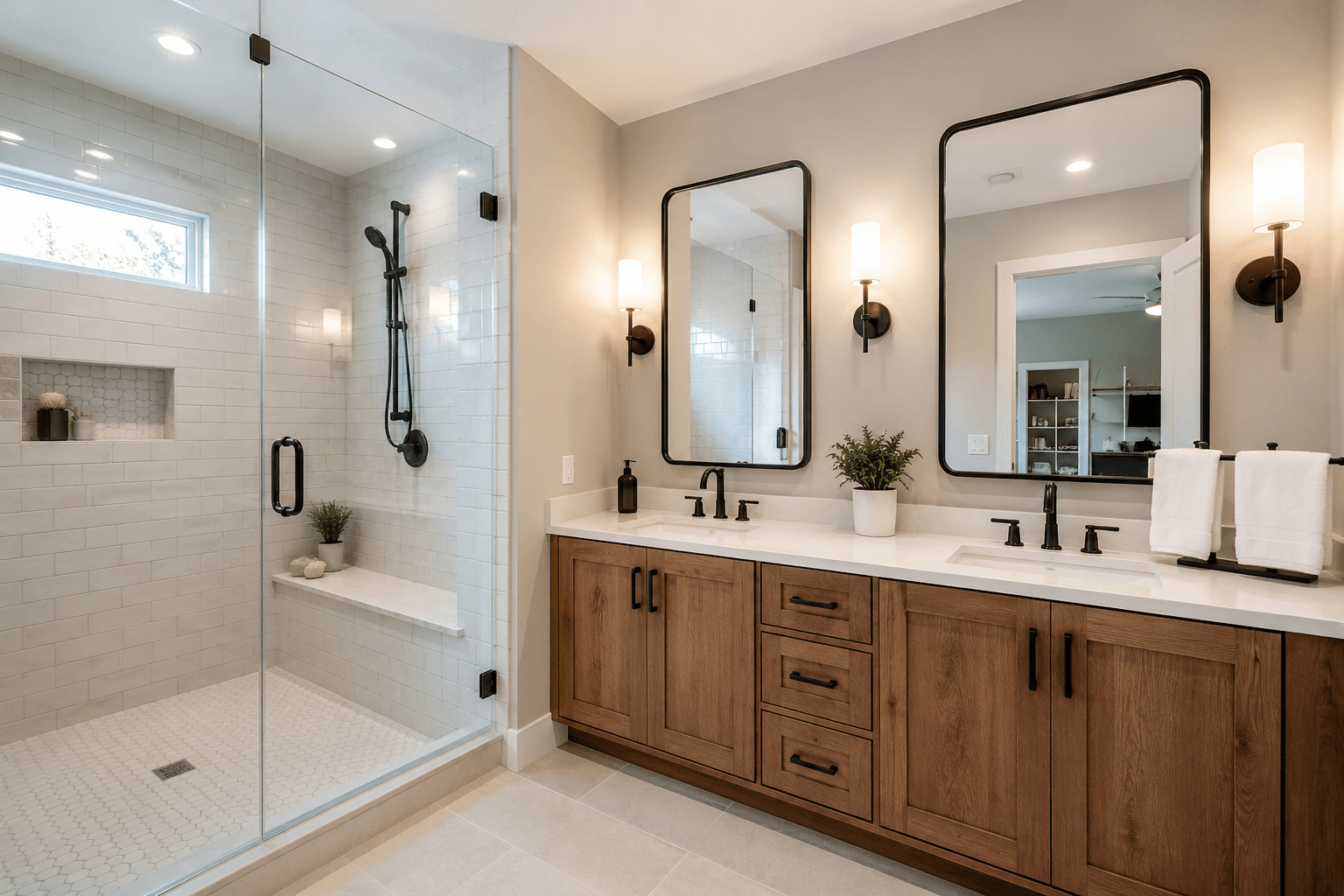
- The shower. For most homes, a clean, well-built walk-in or updated shower is the single biggest value driver. Tub-to-shower conversions in a primary bath tend to please buyers, though keeping at least one tub in the house is smart for families.
- The vanity and countertop. The vanity is the focal point. A quality cabinet with a durable quartz or solid-surface top updates the whole room, and a double vanity is a strong draw in a primary bath.
- Lighting. Layered light, a bright overhead plus vanity lighting that does not throw shadows, makes a bathroom feel new for a modest spend. It is one of the highest-return moves in the room.
- Tile and finishes. Neutral, durable tile reads as timeless and appeals to the widest pool of buyers. Save the bold color for paint and hardware you can swap cheaply later.
- Fixtures and hardware. New faucets, a showerhead, and cabinet pulls in a current finish refresh the room for a few hundred dollars. Water-saving models add appeal and lower a buyer's utility bill.
Universal design: value that grows with the market
Universal design means a bathroom that works for every age and ability: a curbless walk-in shower, grab bars or blocking for them, a comfort-height toilet, and wider clearances. It recoups around 61 percent at resale today, and that number is rising as the buyer pool ages. Beyond ROI, it lets people stay in their homes longer, which is real value that a spreadsheet undersells. Even if you are not planning for it now, adding blocking in the walls for future grab bars costs almost nothing during a remodel and saves a wall demolition later.
Water-saving fixtures: small spend, real appeal
Low-flow toilets, efficient showerheads, and modern faucets are inexpensive and add value out of proportion to their cost. Buyers read them as a cared-for, up-to-date home, and the lower water bill is a tangible selling point. In water-conscious markets they move the needle on their own. This is the rare upgrade that is cheap, practical, and appealing all at once.
What to skip when you remodel for value
If resale is a real goal, a few choices quietly work against you. Ultra-luxury finishes rarely pay back dollar for dollar, because they narrow your buyer pool while raising your cost, which is exactly why upscale remodels recoup so much less. Highly personal design, the dramatic color or the niche layout, can date fast and shrink appeal. And moving plumbing to relocate a toilet or shower is one of the biggest cost multipliers in a bathroom, so do it only when the payoff in function is real.
None of this means build a plain bathroom. It means put personality where it is cheap to change and keep the permanent, expensive elements broadly appealing.
Which upgrades should you prioritize?
If you are working through a budget in order, this is the sequence that protects value:
- First, the invisible function: waterproofing, ventilation, plumbing, and a sound subfloor.
- Then the shower, the highest-impact visible upgrade.
- Then the vanity, countertop, and lighting as a group, since they set the room's whole feel.
- Then durable neutral tile and current fixtures.
- Last, personal touches in paint and hardware you can change without a remodel.
Follow that order and even a paused project looks finished at every stage. If you want it mapped to your actual room, our bathroom remodeling team plans projects this way, and you can see how we approach bathroom remodeling in Bellevue on the Eastside.