If you have been comparing kitchen sinks and the terms have started to blur, there is a reason. Two of the three words in that heading describe the same product, and the third describes something else entirely. Showrooms and manufacturer catalogs use all three loosely, which is how homeowners end up trying to choose between options that are not actually alternatives.
Here is the whole thing untangled, followed by what each choice genuinely demands from your cabinets, your countertop fabricator, and your budget.
Quick answerA farmhouse sink and an apron sink are the same thing. "Apron-front" is the trade term and "farmhouse" is the historical name, both describing a sink whose exposed front panel replaces the cabinet face. Undermount is not a competing style, it is a mounting method, describing a sink fastened beneath the countertop rather than dropped into it. Most apron-front sinks are also undermounted. The real decisions are front face (apron-front or standard), mounting method (undermount or drop-in), and material.
- Two axes, not three options
- What an apron-front sink actually demands
- Undermount reveals, and the term fabricators disagree about
- Which countertops accept which sinks
- Materials, and what each one is actually like to live with
- Single bowl, double bowl, or workstation
- What it costs to plan for
- How to actually choose
- Frequently asked questions
- Choose the sink with the cabinets
Two axes, not three options
Every kitchen sink decision splits along two independent lines. Once you see them as separate, the vocabulary stops being confusing.
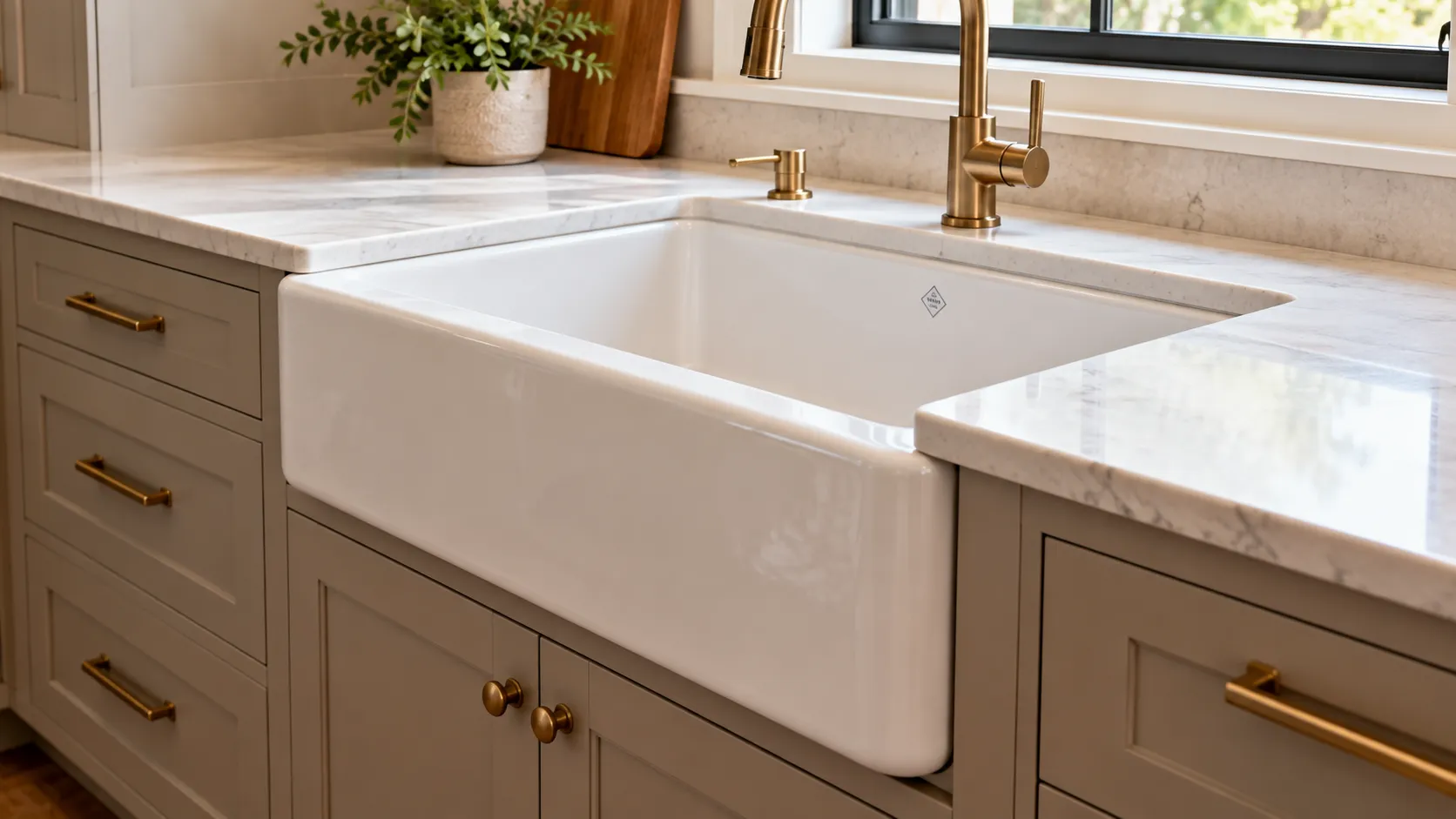
Axis one is the front face. A standard sink sits entirely inside the cabinet, hidden behind a normal door or drawer front. An apron-front sink, also sold as a farmhouse sink, has a finished front panel that projects through the cabinetry and becomes part of the visible elevation. That front panel is the entire point. It is a design statement, and it is also the reason the cabinet underneath has to be built differently.
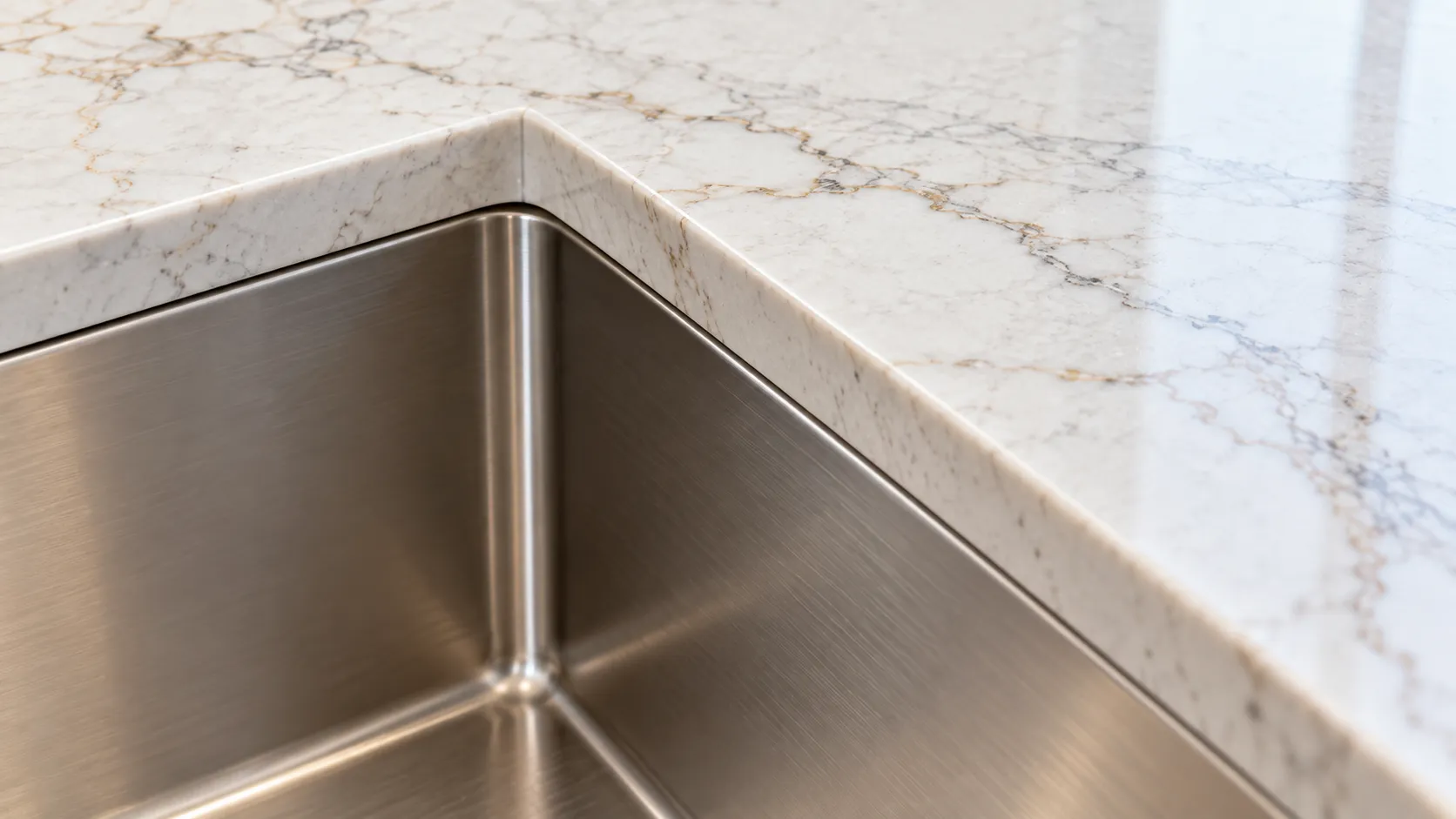
Axis two is the mounting method. A drop-in sink, also called top-mount or self-rimming, has a rim that rests on top of the countertop. An undermount sink is fastened to the underside of the countertop, so the counter surface runs uninterrupted to the edge of the bowl. Farmhouse sinks are a third case: they are typically undermounted, but the apron carries much of the visual weight regardless.
So a sink can be apron-front and undermounted, standard and undermounted, or standard and drop-in. Apron-front with a drop-in style rim exists but is uncommon.
What an apron-front sink actually demands
This is where the choice stops being cosmetic. An apron-front sink is not a fixture you select at the end of a project alongside cabinet pulls. It changes the cabinet, the order of operations, and in some cases the plumbing.
The cabinet has to be built for it. A standard sink base has a face frame and a top rail running across the front. An apron-front sink needs that front removed so the sink's panel can occupy the opening, which means the cabinet is either ordered as a purpose-built farmhouse base or modified in the shop. Door heights change too, because the doors below have to clear the bottom of the basin.
It needs a load path to the floor. Kohler's installation guidance, cited in the trade press, calls for a support cradle capable of carrying 300 pounds, built from three-quarter inch cabinet-grade plywood with direct bearing on the floor rather than hanging off the cabinet sides. That is not over-engineering. A fireclay or vitreous china basin can weigh in the hundreds of pounds empty, and a stone sink can exceed 300 pounds before a drop of water goes in. Fill a large bowl and add a cast iron pot and the load climbs fast. The cabinet also needs a minimum of 24 inches front to back to clear the sink's rounded corners and leave room for a disposal.
The sink has to be on site before the countertop is templated. This is the single most common scheduling mistake, and it is worth understanding why. Fireclay is fired in a kiln, and the finished dimensions vary by roughly plus or minus 2 percent from the published spec. On a 33 inch sink that is more than half an inch of possible variance. A fabricator who templates from the catalog drawing instead of the sink in hand can produce a cutout that does not fit, and stone is not forgiving of a second attempt. Heavy sinks also need to be set and fully supported by the cabinet before the countertop goes on top of them.
Plan the faucet early. Some apron-front designs place the drain toward the front of the bowl, which can complicate disposal and trap routing. If you want a wall-mounted faucet, the backsplash needs to be built out to keep the supply lines clear, and that is a framing decision, not a finish one.
Every one of these is manageable. None of them is manageable if the sink is chosen after the cabinets are ordered. That sequencing trap is the same one behind most of the common kitchen remodeling mistakes we see: finishes selected before the plan is locked.
Undermount reveals, and the term fabricators disagree about
If you go undermount, your fabricator will ask you to pick a reveal. This is the relationship between the countertop cutout and the bowl below it, and it is decided at the stone shop, not at the sink showroom.
Positive reveal means the cutout is slightly larger than the bowl, so a narrow strip of the sink's rim stays visible from above, usually around an eighth of an inch. It is the most forgiving to fabricate, and it hides the epoxy joint between sink and stone. The cost is a small ledge that catches crumbs and needs wiping.
Zero reveal, also called flush, lines the stone edge up exactly with the inside face of the bowl. Nothing is visible but the bowl. It is the cleanest to wipe down and the most demanding to cut, with tolerances measured in sixteenths.
Negative reveal runs the stone out over the bowl wall so the rim disappears underneath. Many people find it the best looking. It is also the hardest to fabricate, because the underside of that overhang has to be polished in a confined space, and the unsupported lip is vulnerable to chipping, particularly in a softer stone like marble.
One practical warning. These three terms are not used consistently across the industry. We have seen fabricator literature that inverts positive and negative, and homeowners who signed off on a word and received the opposite detail. Ask your fabricator to sketch the section or point at a sample. Confirm the geometry, not the vocabulary.
Which countertops accept which sinks
The mounting method constrains the countertop material, and not everyone finds this out in time.
| Countertop | Drop-in | Undermount | Notes |
|---|---|---|---|
| Quartz | Yes | Yes | The most common undermount pairing. Non-porous cut edge. |
| Granite, marble, quartzite | Yes | Yes | Cut edge should be sealed at the sink opening. |
| Solid surface | Yes | Yes | Can be seamed to an integral bowl for a joint-free basin. |
| Porcelain slab | Yes | Yes | Thin slabs may need a reinforced rail at the cutout. |
| Butcher block | Yes | Yes, with care | The exposed end grain around the cutout must be sealed thoroughly and resealed on a schedule. |
| Laminate | Yes | Only with a purpose-built sink | A conventional undermount exposes the particleboard core. Some manufacturers make composite sinks engineered specifically to undermount to laminate. |
| Tile | Yes | Not recommended | The cut edge and grout at the bowl are a persistent water problem. |
Undermounting is also one of the quiet reasons to think about slab thickness. A thicker slab gives the fabricator more material at the cutout and more confidence at the overhang, which we cover in the 2cm versus 3cm countertop guide. And because the cutout, the undermount prep, and the edge polishing are all fabrication labor rather than material, they show up in the fabrication line of your countertop quote rather than in the sink price. Our countertop material breakdown walks through how that split works.
Materials, and what each one is actually like to live with
| Material | Character | Watch for |
|---|---|---|
| Fireclay | The classic farmhouse look. Ceramic clay fired at high temperature, glossy and bright, very hard surface. | Heavy. Dimensions vary from spec because of kiln shrinkage. Can chip if you drop cast iron into it. |
| Enameled cast iron | Deep color range, excellent sound damping, decades of service life. | The heaviest common option. Enamel can chip and the exposed iron will rust at the chip. |
| Stainless steel | Nearly indestructible, light, inexpensive at the low end, easy to undermount. | Gauge matters, and the number runs backward: 16 gauge is thicker than 18. Below 18 the bowl flexes and sounds tinny. Look for sound-damping pads and shows water spots and fine scratches. |
| Granite or quartz composite | Crushed stone bound in resin. Matte, warm, very scratch and heat resistant, quieter than steel. | Light colors can stain from tea or turmeric if left. Not the same product as a quartz countertop. |
| Copper | Living finish that patinas. Naturally antimicrobial. | The patina changes constantly and acidic foods leave bright marks. Not for anyone who wants it to look the same in year five. |
| Natural stone | Carved from a single block, dramatic. | Can exceed 300 pounds empty. Porous and needs sealing. The most demanding support case. |
Single bowl, double bowl, or workstation
Single bowl has become the default in new kitchens, and for a good reason: it is the only configuration that takes a full sheet pan or a roasting rack. If you cook, this usually wins.
Double bowl still earns its place if you wash by hand regularly, or if you want a dedicated disposal side. The compromise is that neither bowl is big enough for the awkward items. Unequal bowl splits, roughly 60/40 or 70/30, get you most of the benefit of both.
Workstation sinks add an integrated ledge, usually stepped into the bowl walls, that accepts sliding cutting boards, colanders, and drying racks. In a small kitchen this is the highest value square foot you can buy, because it turns the sink into working counter space when it is not in use. They are available in most materials, including apron-front.
What it costs to plan for
These are planning ranges for the sink itself. Fabrication, cabinet modification, and plumbing are separate, and they are where an apron-front sink genuinely differs.
| Sink | Typical range |
|---|---|
| Stainless undermount, 16 to 18 gauge | $250 to $900 |
| Granite or quartz composite undermount | $300 to $800 |
| Fireclay apron-front | $600 to $1,900 |
| Enameled cast iron apron-front | $800 to $1,600 |
| Copper apron-front | $900 and up |
| Natural stone | $1,500 and up |
The line items that catch people out are the ones below the sink. A purpose-built or modified farmhouse base cabinet costs more than a standard sink base. The plywood support cradle is labor. And if the apron-front decision arrives after the cabinets are ordered, you are paying for a modification in the field rather than a specification in the shop, which is always the more expensive version of the same outcome.
How to actually choose
Work down in this order and the decision resolves itself.
- Do you want the apron visible in the room? If yes, you are buying a farmhouse or apron-front sink, and you need to decide before the cabinet order goes out. If no, you have more freedom and a lower cost.
- What is the countertop? Stone, quartz, or solid surface opens undermount. Laminate effectively means drop-in unless you buy a sink engineered for it.
- How do you cook? Sheet pans and stockpots point to a single deep bowl. Hand washing points to a split. Limited counter space points to a workstation ledge.
- How much weight is acceptable? Fireclay and cast iron both need the support cradle. Composite and stainless do not.
- Then pick the material and the reveal, and give your fabricator the physical sink before they template.
The pattern behind all five is the same. A sink looks like a late-stage finish selection and behaves like an early-stage structural one. Decide it with the cabinets, not with the faucet.