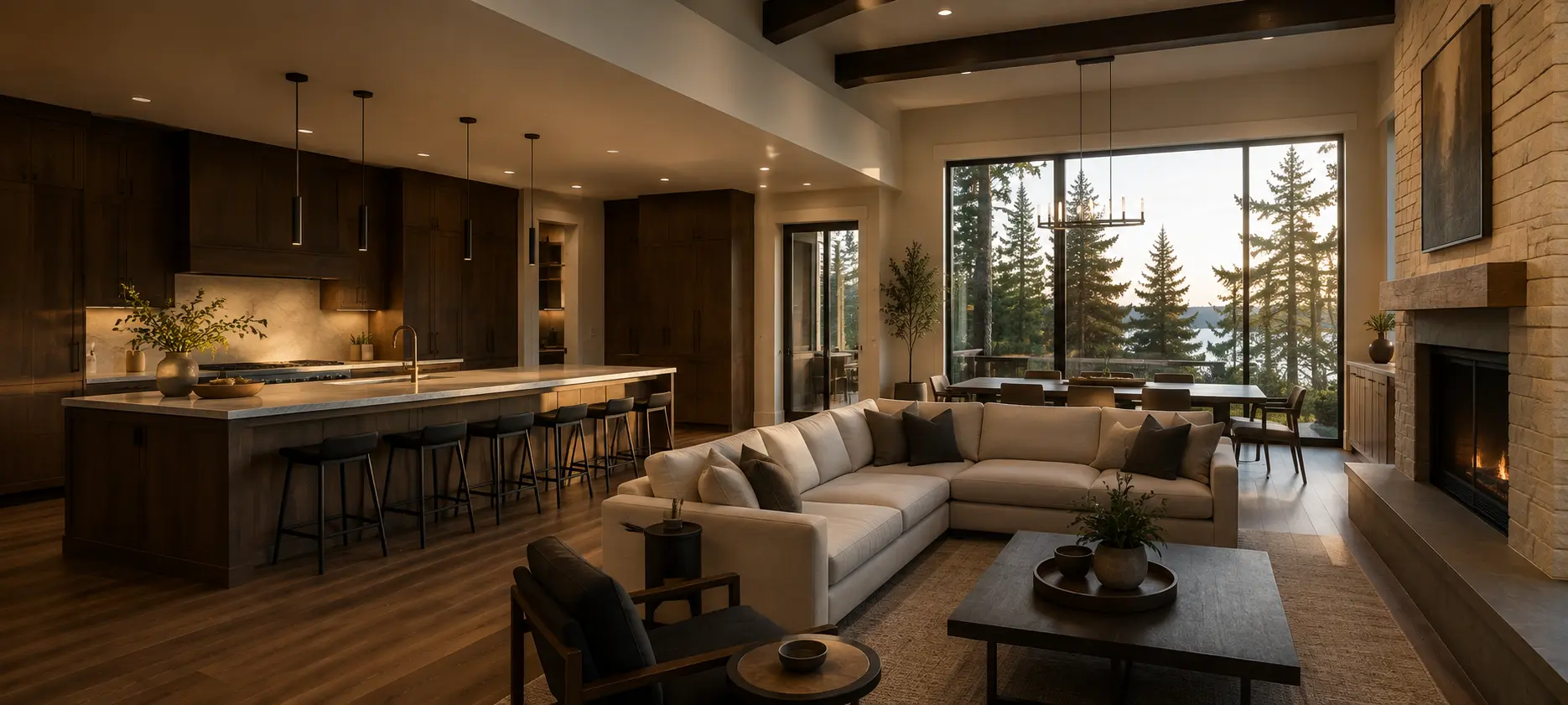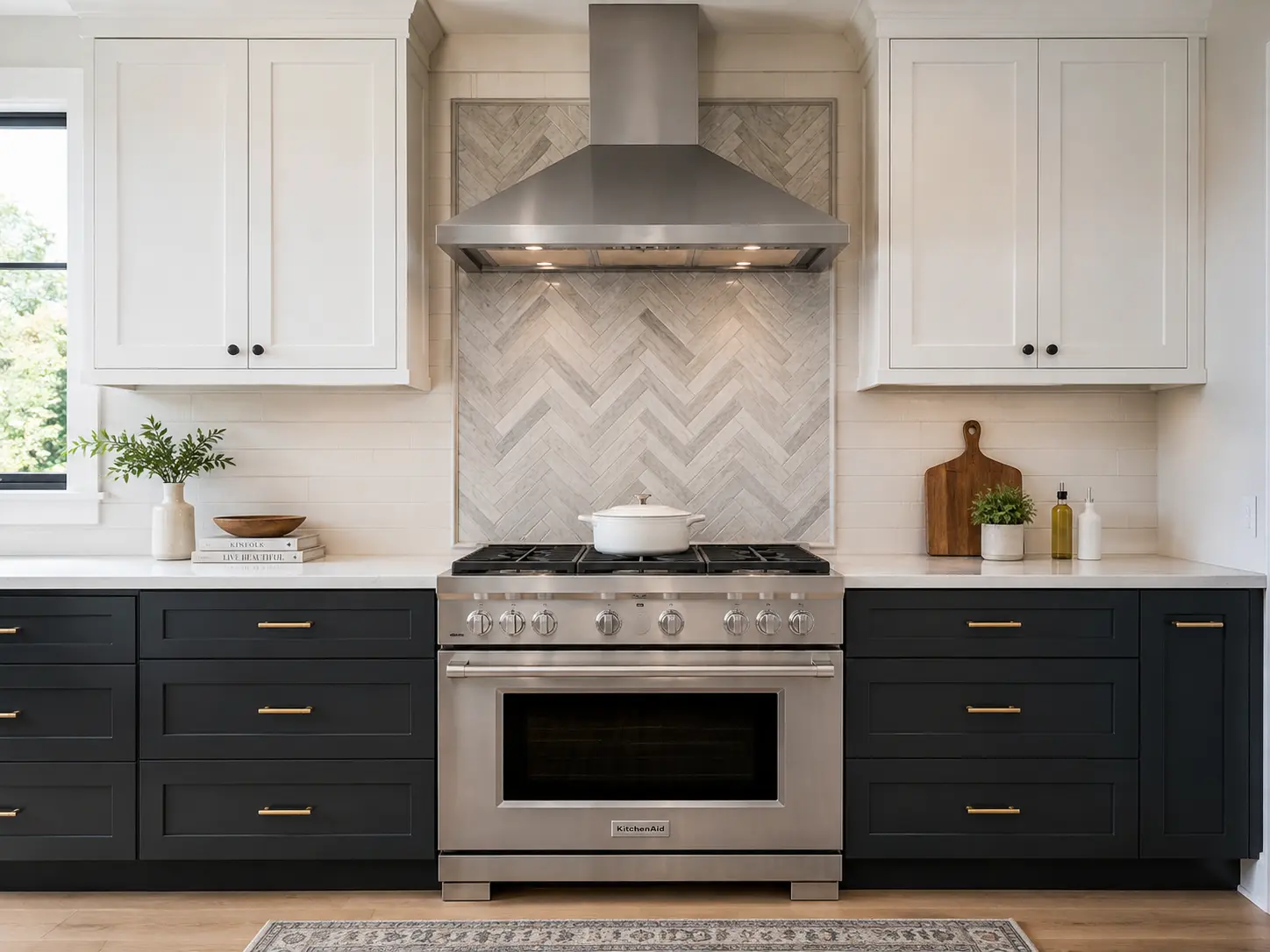
You chose a professional-style range and a hood to match, something rated at 600 or 900 or 1,200 cfm. Then someone on the project says two words that can add real cost and complexity: makeup air.
Here is the part most homeowners, and a surprising number of online articles, get wrong. The rule that "any range hood over 400 cfm needs makeup air" is outdated. The code changed, and under the version in force in Washington today, a great many kitchens with powerful hoods are not required to have makeup air at all.
This guide explains what the current code actually says, why the rule exists, when it applies, and why you might want makeup air even when the code does not require it.
Quick takeUnder current code in Washington, a range hood capable of more than 400 cfm requires makeup air only when the home contains a fuel-burning appliance, inside the air barrier, that is neither direct-vent nor mechanically vented. An all-electric home, or one where every combustion appliance is sealed and direct-vented, is generally not triggered. Even so, a large hood in a tight modern house may not perform well without replacement air, so the decision is worth making on physics as well as code.
- What makeup air actually is
- Why the rule exists: backdrafting
- What the current code says
- When the rule applies, in practice
- The all-electric advantage
- Why you might want makeup air anyway
- How makeup air systems work
- Other Washington kitchen exhaust requirements
- The smartest move: size the hood honestly
- Frequently asked questions
- Plan the air, not just the hood
What makeup air actually is
A range hood does not remove air from a sealed box. Every cubic foot it exhausts to the outdoors has to be replaced by a cubic foot coming in from somewhere. Makeup air is simply a planned, controlled path for that replacement air.
Without a planned path, the house finds one. Air gets pulled in through gaps around windows and doors, through the attic, through the crawl space, and, most dangerously, back down the flue of a gas water heater or furnace.
That last path is the entire reason the code rule exists.
Why the rule exists: backdrafting
Many older gas appliances vent their exhaust by natural draft. Hot combustion gases rise up the flue on their own, relying on a gentle upward flow. They need the house to stay close to neutral pressure to work.
A powerful range hood depressurizes the house. Pull enough air out and the pressure inside drops below the pressure outside. When that happens, the easiest path for replacement air can become the water heater or furnace flue, running backward. The exhaust gases that should be going up the chimney get pulled into the living space instead. Those gases include carbon monoxide.
Understanding that purpose explains why the code changed. If nothing in the house can backdraft, the safety rationale disappears.
What the current code says
This is the change that matters.
The 2015 International Residential Code required makeup air for any exhaust hood capable of more than 400 cfm, with no conditions. That is the version many articles still quote, and it is out of date.
From the 2018 edition onward, the rule in Section M1503.6 became conditional. It now applies only where one or more gas, liquid, or solid fuel-burning appliance that is neither direct-vent nor uses a mechanical draft venting system is located inside the dwelling unit's air barrier. Where that condition exists, each exhaust system capable of more than 400 cfm must be mechanically or passively provided with makeup air at a rate approximately equal to the exhaust rate.
There is one stated exception: makeup air is not required for exhaust systems installed solely for space cooling and intended to run only when windows or other air inlets are open.
Washington's position. Washington amends the residential code through WAC 51-51. The current amendments to Section M1503, effective March 15, 2024, revise the open-top broiler, exhaust discharge, and exhaust rate provisions, but they do not amend M1503.6. The conditional model code language therefore governs in Washington.
When the rule applies, in practice
The requirement targets appliances that rely on natural draft to vent combustion gases. In practical terms, the homes most likely to trigger it contain one or more of these inside the air barrier:
- An older gas water heater venting through a standard flue
- A gas furnace that is not a sealed, direct-vent high-efficiency unit
- A wood-burning or gas fireplace with an open, naturally drafting flue
The homes least likely to trigger it are those where combustion appliances are direct-vent (sealed combustion drawing air from outside through a dedicated pipe), mechanically vented (using a fan to push exhaust out), or absent entirely.
One question deserves a direct answer from your building department rather than from any article: how your specific appliances are classified. That includes a gas range or cooktop, which is not vented to the outdoors in the same way as a water heater or furnace. Classifications and local interpretation vary, so settle this during design, before the hood is ordered.
The all-electric advantage
This is where the code change becomes genuinely useful. An all-electric home, with an induction or electric range, a heat pump for heating, and an electric or heat pump water heater, has no fuel-burning appliance to backdraft. Under the current rule, that home is generally not required to provide makeup air, even for a large hood.
That is a meaningful point in favor of electrification during a kitchen remodel. Removing the last naturally vented gas appliance can take the makeup air question off the table from a code standpoint, while also improving indoor air quality. We cover the broader case for all-electric kitchens in our guide to eco-friendly remodeling.
Why you might want makeup air anyway
The code tells you the minimum for safety. It does not tell you whether your hood will actually work.
Modern Washington homes are built tight to meet the energy code. A tight house simply does not leak enough air to feed a large hood. Try to exhaust several hundred cfm from a well-sealed house with no replacement path and a few things happen:
- The hood underperforms. It cannot move air it cannot replace, so a hood rated at 900 cfm may deliver a fraction of that, and the cooking smoke and grease it was bought to capture stay in the kitchen.
- Doors become hard to open, and you may hear whistling at gaps and around windows as air forces its way in.
- Air comes from where you do not want it, such as the attic, the crawl space, or the garage, bringing dust, odors, or worse.
So even in an all-electric home where the code does not require it, a high-capacity hood in a tight house is a strong candidate for planned makeup air. The requirement and the recommendation are two different questions.
How makeup air systems work
Where makeup air is required or chosen, the system has a few essential parts.
An outdoor air intake and duct bringing air in from outside.
A damper that opens when the hood runs and closes when it stops, so the house is not permanently open to the outdoors. Code requires dampers to be accessible for inspection, service, and replacement. A motorized damper interlocked with the hood is the common approach.
A control interlock so the makeup air starts automatically. Washington's testing requirements specifically call for verifying that a required mechanical makeup air system is controlled to start automatically, which means it cannot rely on someone remembering to open a vent.
Delivery into the right space. Makeup air must be delivered where it can actually replace what the hood removes, which means the kitchen or a space that connects to it.
Tempering, where it matters. Here is the comfort issue nobody mentions in the showroom. On a cold January evening, a 600 cfm hood can pull a substantial stream of outdoor air into your kitchen. Untempered, that is a cold draft across the room. Many systems therefore heat the incoming air, which adds cost and complexity but makes a large hood livable in winter.
Other Washington kitchen exhaust requirements
Makeup air is one piece of a broader set of Washington rules for kitchen exhaust. These apply regardless of hood size.
Ducted to the outdoors. Kitchen exhaust must discharge outside through a duct with a smooth interior surface, airtight, fitted with a backdraft damper, and independent of other exhaust systems. It may not terminate in an attic, crawl space, or anywhere else inside the building. A listed and labeled ductless hood is permitted only in limited conditions, where installed per the manufacturer and where continuous local exhaust is provided in an enclosed kitchen.
Airflow or capture efficiency. Washington allows a range hood to comply by meeting either a minimum airflow or a minimum capture efficiency. Capture efficiency measures how much cooking pollution the hood actually catches, which is a more meaningful number than raw cfm. A well-designed hood can outperform a more powerful but poorly shaped one.
Downdraft minimum. Other intermittent kitchen exhaust, including downdraft systems, must meet or exceed 300 cfm.
Testing. Kitchen exhaust must be tested to verify it achieves the required airflow or capture efficiency, and where makeup air is required, that testing includes confirming the makeup air starts automatically.
The smartest move: size the hood honestly
The cheapest makeup air system is the one you do not need. Before specifying a 1,200 cfm hood because it looks the part, consider what the cooking actually requires.
A hood at or under 400 cfm avoids the makeup air question entirely under the code. A hood chosen for strong capture efficiency, sized and shaped correctly for the range beneath it, often clears smoke better than a larger, poorly matched unit. And an all-electric kitchen removes the backdrafting risk that drives the requirement in the first place.
The right answer depends on how you cook, what fuel your appliances use, and how tight your house is. Those are the three variables to settle during design.
If you are planning a larger renovation, makeup air belongs in the same conversation as your electrical service and HVAC, which our guide to structural and infrastructure upgrades covers.