Most kitchen trends have a shelf life you can predict. The high-gloss slab doors, the saturated feature color, the busy patterned tile. They look current for a few years and dated for a decade after.
White Shaker cabinetry is the exception. It has anchored kitchens for generations, and it keeps working because it does not ask for attention. It is a frame rather than a statement, which means it adapts to whatever surrounds it. Change the hardware, the counters, and the light, and the same white Shaker kitchen can read farmhouse, traditional, transitional, or quietly modern.
That flexibility is also its risk. Done without thought, white Shaker is the default of every builder-grade spec, and it can feel generic. Here are seven ways to make it feel considered, followed by the choices that decide whether it looks timeless or just safe.
Quick takeWhite Shaker endures because its simple five-piece door and restrained proportions work with nearly any style. The difference between timeless and generic comes from the details around it: the right white for your light, a counter and hardware with character, some warmth from wood or texture, and a finish built to survive a working kitchen.
- What makes a door "Shaker"
- 1. Warm white with brass or bronze hardware
- 2. Two-tone: white uppers, a darker base
- 3. Add warmth with natural wood
- 4. Take the cabinets to the ceiling
- 5. Let the counter carry the character
- 6. Contrast the flat panel with texture
- 7. Go inset for a furniture-grade feel
- Choosing the right white
- Choosing a finish that lasts
- How to avoid the builder-grade look
- Frequently asked questions
- Timeless is a set of decisions
What makes a door "Shaker"
Before the ideas, the definition, because a lot of doors get called Shaker that are not.
A Shaker door is a five-piece construction: two vertical stiles, two horizontal rails, and a flat recessed center panel set within that square frame. There is no raised panel, no decorative routing, no arch. The style takes its name from the Shakers, a religious community known for furniture defined by simplicity, proportion, and function.
That restraint is precisely why it lasts. There is nothing on the door to go out of fashion.
1. Warm white with brass or bronze hardware
The fastest way to lift white Shaker above builder grade is to change the metal. Chrome and brushed nickel on white read cool and familiar. Warm brass, unlacquered brass that patinates over time, or oil-rubbed bronze add depth and a sense of age.
Pair a warm white with warm metal and the kitchen feels collected rather than installed. Cup pulls on drawers and simple knobs on doors reinforce the traditional character, while slim bar pulls push it toward transitional.
2. Two-tone: white uppers, a darker base
White on every cabinet can make a kitchen feel light but ungrounded. Keep the uppers white and move the base cabinets, or just the island, to a deeper tone: a navy, a forest green, a warm greige, or a charcoal.
The darker base anchors the room visually, hides scuffs where feet and knees make contact, and keeps the upper half of the kitchen bright and open. It is one of the most reliable ways to add personality without committing the whole room to a color you might tire of.
3. Add warmth with natural wood
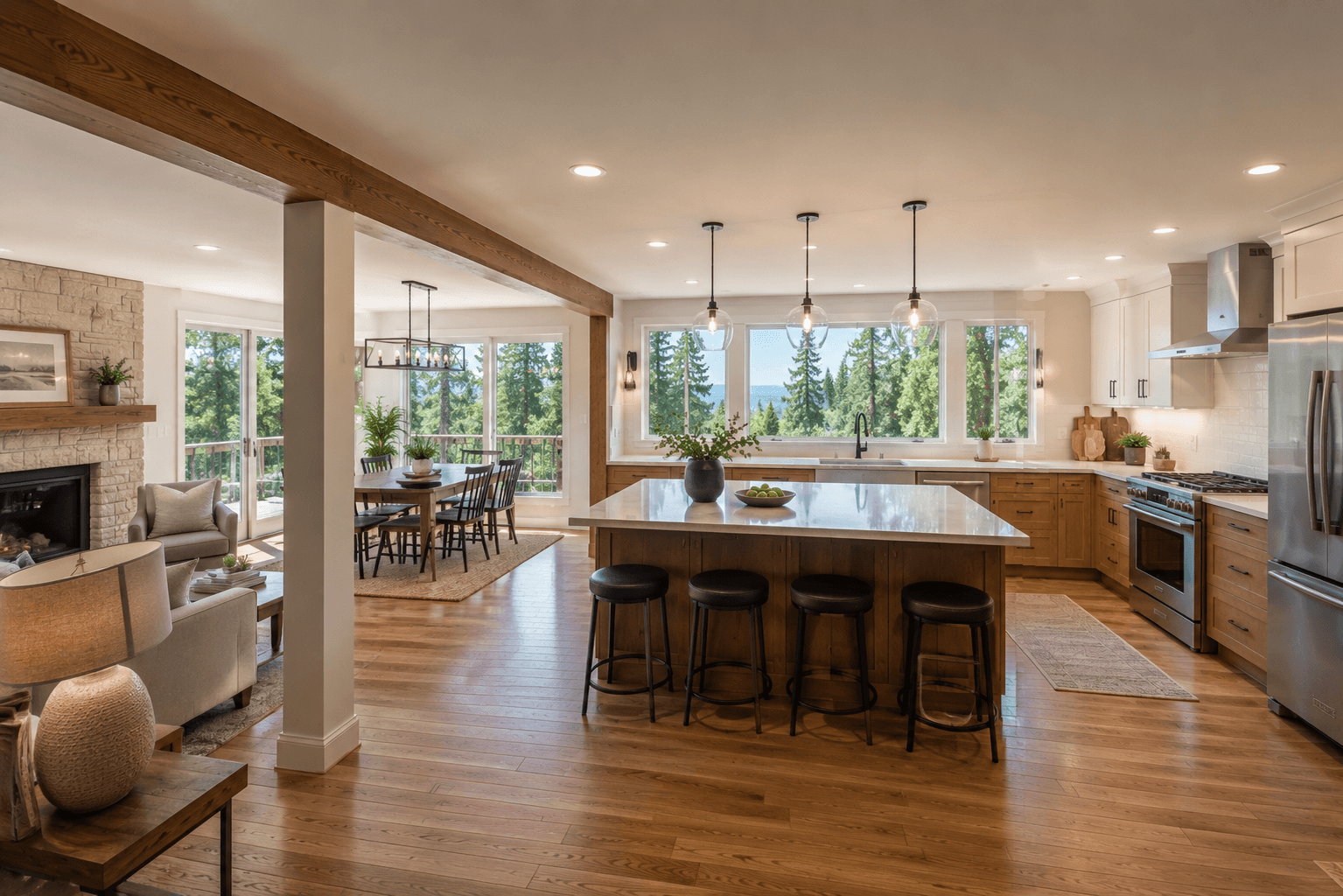
An all-white kitchen can tip toward clinical. Wood fixes that immediately. A white oak or walnut island, open wood shelving in place of a run of uppers, a wood range hood surround, or even just wood cutting boards leaning against the backsplash all soften the room.
White oak in particular pairs beautifully with warm white Shaker. The combination reads natural and relaxed, and because wood ages rather than dates, it keeps the kitchen from feeling like a moment in time.
4. Take the cabinets to the ceiling
Stock upper cabinets often stop well short of the ceiling, leaving a dusty gap or a flat soffit above. Running white Shaker cabinetry all the way up, finished with crown molding, makes the kitchen feel taller, more architectural, and deliberately built rather than assembled.
It also adds genuine storage for items you use a few times a year. The top tier can hold holiday platters and seasonal pieces, reachable with a step stool, while the lower tiers stay for everyday use.
5. Let the counter carry the character
With a door this quiet, the countertop does the talking. That is an opportunity. A honed black stone or soapstone reads classic and grounding against white. A veined marble or marble-look quartz adds movement. A butcher block island introduces warmth and a working surface.
The counter is where you can take a stronger position without risking the longevity of the cabinetry, because counters are easier to change than a full set of doors. For help choosing, our guide to the best kitchen countertops for home value compares the options.
6. Contrast the flat panel with texture
Shaker doors are smooth and planar. Surround them with texture and the whole room gains depth. A handmade or zellige-style tile backsplash with its uneven glaze, a textured plaster range hood, or a vertically stacked subway tile all play against the clean door fronts.
The contrast between the flat, crisp cabinetry and a surface with visible handwork is what makes a white Shaker kitchen feel crafted. Our roundup of affordable backsplash ideas covers several that suit this approach.
7. Go inset for a furniture-grade feel
The standard white Shaker kitchen uses full overlay doors, which sit on top of the cabinet frame. Specifying inset Shaker, where the doors sit flush inside the frame, changes the character entirely. The visible frame around each door and the fine, even reveal read as custom furniture rather than stock cabinetry.
Inset costs more and demands precision, but for a traditional home it is the single most elevating choice you can make on a Shaker kitchen. Our comparison of inset versus full overlay cabinetry explains the construction and trade-offs.
Choosing the right white
"White" is not one color, and choosing the wrong one is the most common way a white kitchen goes flat.
Warm whites carry a slight cream or yellow undertone. They feel soft, inviting, and traditional, and they pair naturally with brass, wood, and warm stone.
Cool whites carry a blue or grey undertone. They read crisp and clean, suit modern and minimal kitchens, and pair with chrome, black, and cool stone.
Test in your own light. This matters more than any sample in a showroom. A white that looks perfect under bright showroom lighting can turn cold and grey under overcast northern daylight, or yellow under warm evening bulbs. Paint large samples on the actual wall or on boards, and look at them at different times of day, including a grey afternoon, before you commit. In low-light climates especially, a white with a touch of warmth usually holds up better than a stark cool white.
Choosing a finish that lasts
The finish decides whether a white kitchen still looks fresh in ten years.
Sheen matters for cleaning. A satin or semi-gloss finish wipes clean far more easily than a flat finish, which absorbs grease and fingerprints. In a working kitchen, some sheen is practical, not just aesthetic.
Durable coatings resist chipping. Factory-applied catalyzed finishes, such as conversion varnish, are harder and more resistant to chipping and moisture than a standard site-applied paint. They are worth specifying on cabinetry that will take daily abuse.
Be cautious with thermofoil near heat. Thermofoil, a vinyl film bonded over a substrate, is affordable and uniform, but it can discolor, bubble, or peel when exposed to repeated heat, which makes it a poor choice beside ovens, cooktops, and dishwashers that vent steam.
How to avoid the builder-grade look
White Shaker becomes generic when every choice is the default. The recipe for that look is predictable: cool white doors, chrome hardware, a plain grey counter, and uppers that stop short of the ceiling.
Break the pattern in two or three places and the same cabinetry becomes distinctive. Warm the white, change the metal, bring in wood, take the cabinets to the ceiling, or give the counter a strong character. You do not need all seven ideas. You need enough of them that the kitchen reflects a decision rather than a default.